
Visible varicose veins do not automatically rule out a gynecological operation, but they do belong in the preoperative risk assessment. You will learn which symptoms need urgent evaluation, how surgery type and anaesthesia affect clot risk, and which questions to ask before agreeing to a date.
Key takeaways
- Stable varicose veins do not automatically prevent gynecological surgery.
- Report one-sided swelling, warmth, pain, or sudden breathlessness urgently.
- Ask how your VTE and bleeding risks will be assessed before surgery.
- Early movement, compression, and prescribed blood thinners can reduce clot risk.
Do Varicose Veins Automatically Prevent Gynecological Surgery?
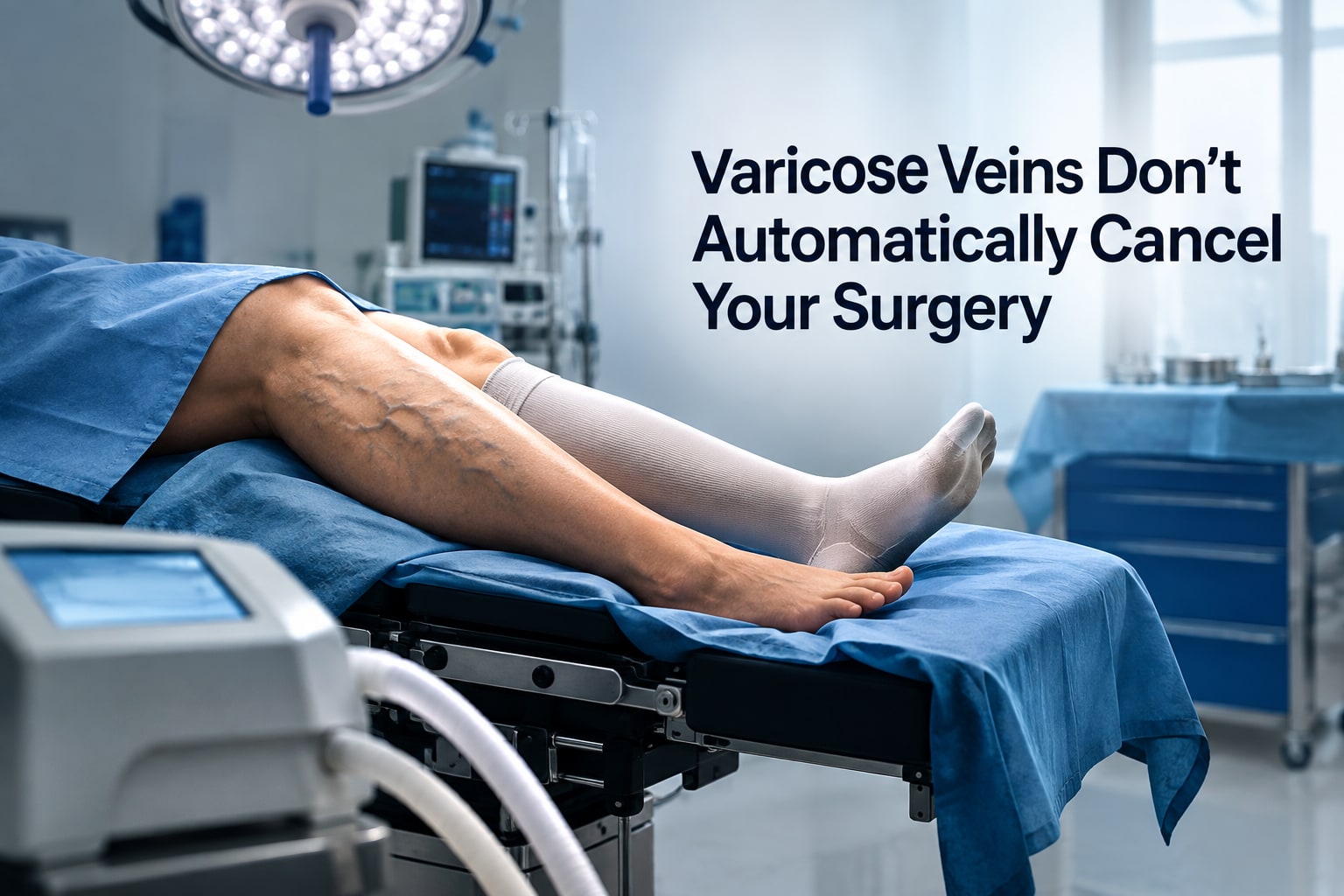
Stable, uncomplicated varicose veins do not automatically require cancellation of gynecological surgery or treatment before the operation. The decision depends on your complete venous-thromboembolism (VTE) and bleeding risk, not on how prominent the veins look.
Before planned gynecology surgery in Pune, the surgical and anaesthesia teams assess:
- Previous deep-vein thrombosis or pulmonary embolism, known thrombophilia, and a family history of clots.
- Active cancer, major immobility, older age, obesity, smoking, and hormone use such as oestrogen-containing contraception or hormone therapy.
- The operation’s type and duration, anaesthesia, expected mobility afterwards, and factors that increase bleeding risk.
Tools such as the Caprini model score these factors separately. Varicose veins count as one factor; they do not represent the entire score or automatically prohibit surgery.
You do not usually need varicose-vein treatment first. Further assessment or treatment becomes important when veins are painful, ulcerated, infected, bleeding, affected by superficial thrombophlebitis, or linked to a suspected or previous clot. An active vein problem can alter the timing, clot-prevention plan, or need for specialist input.
The plan can change if your health worsens, you develop new leg symptoms, or the scheduled procedure changes from a short diagnostic operation to prolonged laparoscopy, open pelvic surgery, or cancer surgery.
How Can You Tell Varicose Veins from a Dangerous Clot?
The key question with varicose veins before surgery is whether the veins are stable and superficial or whether a new clot is developing deeper in the leg. Long-standing veins that are soft, visible and unchanged do not prove a clot. Acute deep-vein thrombosis (DVT) cannot be diagnosed by appearance alone.
| Finding | More consistent with | What to do |
|---|---|---|
| Stable, soft, visible veins unchanged for years | Superficial varicose veins | Routine ultrasound is not required solely for this history |
| New swelling or pain in one leg | Possible DVT or another venous complication | Seek prompt medical assessment |
| Breathlessness or chest symptoms with leg concerns | Possible pulmonary embolism | Seek emergency care immediately |
Seek prompt assessment before an operation for:
- New one-sided leg swelling, sudden calf pain, warmth, redness, tenderness or rapidly worsening symptoms.
- Sudden breathlessness, chest pain, coughing blood, fainting or an unexplained rapid heartbeat. These symptoms can indicate a pulmonary embolism and require emergency care.
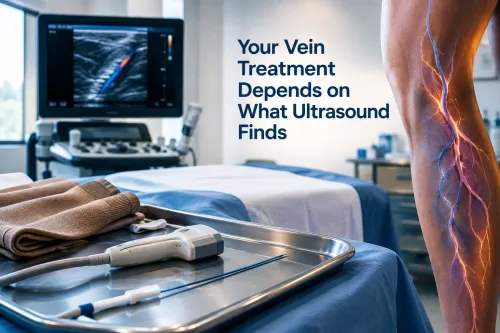
A duplex Doppler ultrasound helps when DVT is suspected, the vein anatomy is uncertain, a venous complication is suspected, or a venous procedure is being planned. Stable varicose veins alone do not make this scan necessary; the surgical team can arrange it when symptoms or examination findings justify further assessment.
What Should You Ask at the Preoperative Assessment?
Bring a written list of every clot, bleeding problem, medicine and hormone treatment to the assessment. The surgeon and anaesthetist should document your individual VTE and bleeding risks, expected operation, anaesthesia, mobility after surgery and any change that could alter the plan.
1. Do I need a vascular examination, or are my veins stable enough for routine surgical planning?
2. Is duplex Doppler ultrasound indicated because I have new symptoms, uncertain vein anatomy, a suspected clot or a planned venous procedure?
3. What is my individual VTE risk score, such as a Caprini score, and which factors increased it?
4. Will I receive intermittent pneumatic compression, graduated compression stockings, low-molecular-weight heparin, or a combination? Ask when mechanical prevention will start and when it can stop.
5. If I take warfarin, apixaban, rivaroxaban, aspirin or another anticoagulant, who will manage it, and when should it be stopped or restarted?
6. How do bleeding risk, kidney function, neuraxial anaesthesia, the operation and my current medication affect drug timing?
Stockings need correct measurement, pressure and fitting; they are not suitable for everyone, including some people with significant peripheral arterial disease. Do not buy or start them without assessment.
For a gynecological surgery consultation in Pune, Pawar Surgical Hospital -Premier Surgical care center for gastroenerology, general surgery, laparoscopy, Urology and Gyenacology can coordinate gynecology, anaesthesia and, when indicated, vascular teams. A gynecology specialist in Pune should judge the complete risk record, not visible veins alone.
Related items
 | Surgery Gynecology Many females start suffering from excessive P/V bleeding due to various reasons. |
Hernia Hydrocele Debridement Varicose veins Varicocele Lipomas Lymphnode All lumps and bumps View service → |
How Do the Operation and Its Timing Change the Decision?
A short diagnostic laparoscopy does not carry the same clot risk as a prolonged hysterectomy, ovarian or fibroid operation. Anaesthesia, reduced leg movement, pneumoperitoneum, steep Trendelenburg positioning, operating time and bed rest can all slow venous flow.
| Procedure | Relative concern | Why it changes the plan |
|---|---|---|
| Short diagnostic laparoscopy | Lower | Brief anaesthesia and earlier walking reduce exposure, but do not remove VTE risk. |
| Prolonged laparoscopy | Moderate to higher | Pneumoperitoneum, tilted positioning and limited movement increase venous stasis. |
| Open pelvic surgery | Higher | Larger tissue injury, longer recovery and reduced mobility add clot risk. |
| Cancer surgery | Often highest | Cancer and major abdominal or pelvic surgery can require stronger or extended prophylaxis when bleeding risk permits. |
Minimally invasive surgery may shorten wound recovery, but it does not make VTE impossible. The team must match compression and anticoagulant decisions to clot risk, bleeding risk, kidney function and expected mobility.
An elective operation can be rescheduled while painful, ulcerated, infected or bleeding veins, recent superficial thrombophlebitis, suspected DVT, or a previous DVT or pulmonary embolism receive specialist assessment. Do not postpone suspected ectopic-pregnancy surgery or treatment for heavy bleeding causing anaemia independently; the surgeon and anaesthesiologist must decide urgently.
For gynecology surgery with varicose veins in Pune, ask whether the operation’s duration and approach alter prophylaxis. The same applies to gynecology surgery in Pune generally: emergency need overrides convenience, while planned care allows time to investigate and treat an active vein problem.
What Happens After Surgery to Reduce Clot Risk?
Walk as soon as the surgical team permits. While you remain in bed, perform ankle pumps and gentle leg movements, drink enough fluid unless fluid restriction applies, and avoid unnecessary bed rest.
| Measure | What to do | Why it matters |
|---|---|---|
| Early walking | Ask when you may stand and walk | Restores venous flow |
| Bed exercises | Flex and point your ankles regularly | Reduces stasis while you cannot walk |
| Prescribed compression | Wear stockings correctly and keep them smooth, not rolled | Uneven pressure can injure skin or restrict circulation |
Intermittent pneumatic compression often begins before surgery or on admission and continues until walking is adequate when your assessed VTE risk warrants it. Use graduated compression stockings only after proper selection and fitting; significant peripheral arterial disease can make them unsuitable.
Never start, stop or restart an anticoagulant without instructions. Bleeding risk, kidney function, anaesthesia, the operation and your existing treatment determine the timing.
For gynecology surgery with varicose veins in Pune, use this checklist:
- Disclose every previous clot, medicine, hormone treatment and mobility problem.
- Report new leg swelling, chest pain, breathlessness or coughing blood immediately.
- Ask when normal walking is expected.
- Confirm whether a gynecology specialist in Pune will coordinate with anaesthesia, vascular medicine or haematology when indicated.
This approach supports prevention without treating varicose veins alone as a reason to refuse surgery.
Frequently asked questions
Do varicose veins automatically prevent gynecological surgery?
No. Stable, uncomplicated varicose veins do not automatically require cancellation or treatment before surgery. Your clinician will assess your overall VTE and bleeding risk.
How can you tell varicose veins from a dangerous clot?
Varicose veins are usually visible, twisted veins near the skin. Seek urgent medical assessment for new one-sided leg swelling, pain, warmth, redness, sudden breathlessness, chest pain, coughing blood, or fainting.
What should you ask at the preoperative assessment?
Ask how your personal VTE risk, bleeding risk, planned procedure, mobility, previous clots, medicines, and need for compression or anticoagulants will affect the surgical plan.
How do the operation and its timing change the decision?
The procedure's duration, extent, anesthesia, expected mobility, and urgency affect clot risk. Your surgeon and anesthetist use these factors with your medical history to plan timing and prevention.
What happens after surgery to reduce clot risk?
The care team may encourage early movement, use leg compression devices or stockings when appropriate, and prescribe anticoagulants when the expected clot risk outweighs bleeding risk.
Related items
 | Nissan's Fundoplication Appendectomy, Cholecystectomy, Inguinal Hernia, Incisional Hernia, Hiatus Hernia, Hysterectomy, ectopic pregnancy, ovarian tumors, PCOD, Diagnostic... View product → |
Laparoscopy Laparoscopic apendicectomy Laparoscopic cholecystectomy Laparoscopic Hiatus Hernia Laproscopic Inguinal Hernia Laparoscopic Umbilical Hernia... View service → |